
 Tara Sethi
Building Consistency and Standards
Inconsistencies, bugs, and defects in NativeEdge had been raised to leadership. I audited the whole application, then built the plan and the design guide that gave design, product management, and engineering one shared standard.
- Role
- Senior Product Designer
- Collaborators
- Product Management, Engineering, and Supporting Designer
- Methods
- Heuristic review, design system consistency check, and severity and cause analysis
- Scope
- UX quality and consistency audit of NativeEdge
- Status
- Critical issues fixed, guide in use by developers and designers
The Problem
NativeEdge did not start from scratch. It was assembled from three products Dell had acquired to bring the technology to market quickly. The speed left inconsistent patterns, bugs, and defects, and there was no common UX standard to check against. The risks were user confusion, failed tasks, and design and engineering working from different assumptions. I was brought in to learn the application, run a heuristic review and analysis, and develop a plan with design, product management, and engineering.
Process
- Evaluated the applicationRan a heuristic review across the entire application.
- Documented each issueCaptured each one with its solution, its locations, and a severity rating.
- Traced the causeNoted whether each pattern was consistent with the design system and, if not, whether the product needed a custom component.
- Identified required componentsListed the components needed to build a consistent application.
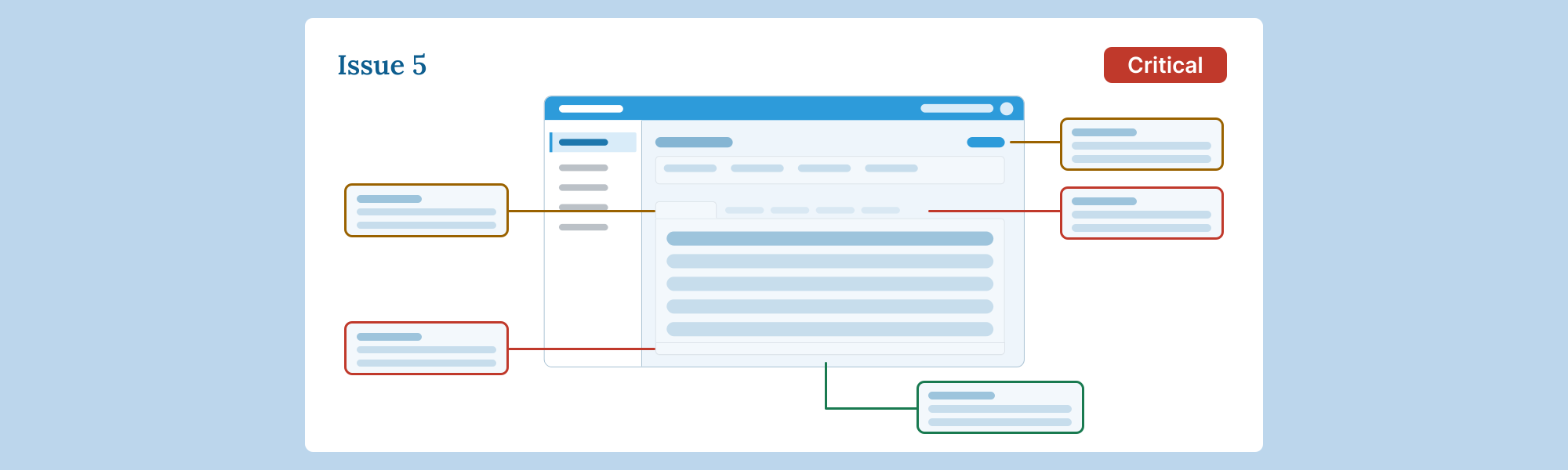
- Turned findings into actionPresented the findings and plan to product management and engineering, with an annotated illustration for every issue. Engineering used the illustrations to understand each problem and own the resulting defects, while product management created features and enhancements.
What I Found
18 issues, 13 of which occurred on multiple pages across the application.
By Severity
- Critical
- 5
- Medium
- 4
- Low
- 8
- Other
- 1
By Cause
- Engineering bugs
- 8
- Not using the design system
- 4
- UX gaps
- 3
- No common component available
- 2
- No requirement available
- 1
Outcome
- Created a detailed NativeEdge Design Guide in Figma. It documents the framework and foundations of each page, which components come from the broader design system, and which are custom to NativeEdge.
- Entered the critical issues into Jira as tickets immediately, and engineering fixed them as part of this effort.
- Developers adopted the NativeEdge Design Guide quickly, and it soon became a collaborative source of truth for consistent design and development.
- As the product evolved and the design team grew, the NativeEdge Design Guide became fundamental in onboarding new designers. It communicated which patterns existed and which components were unique to NativeEdge, and it gave designers a benchmark to check their designs against.