
 Tara Sethi
Designing a Unified Platform
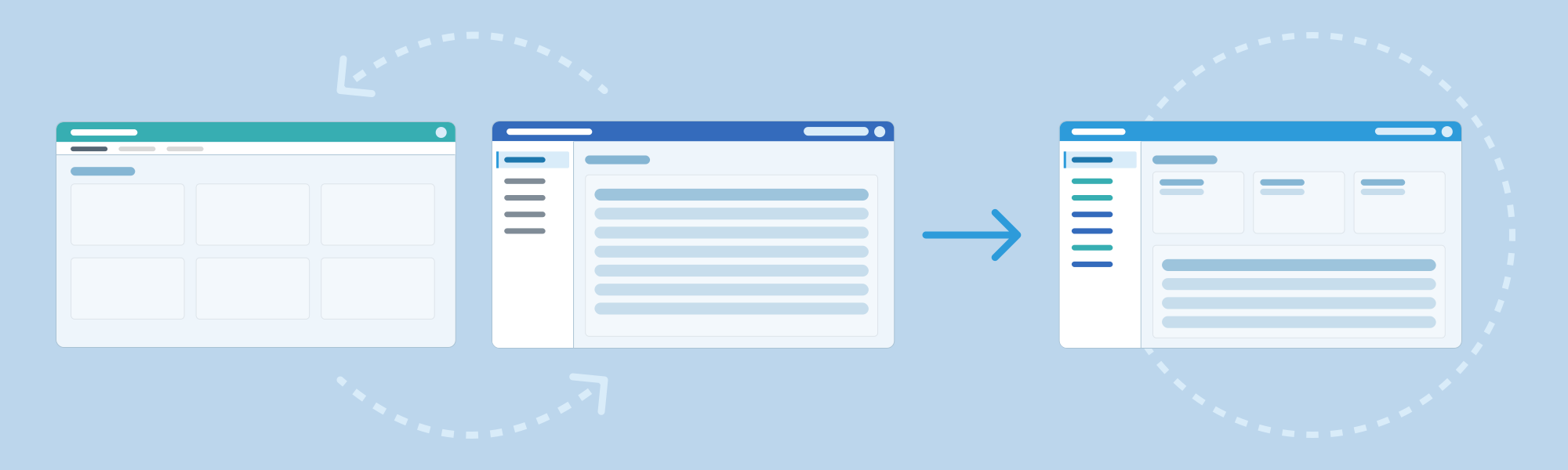
The platform launched as two separate apps, so users had to move between them to complete related tasks. Working with product management before requirements existed, I defined one unified experience.
- Role
- Design Lead
- Collaborators
- Product Management, Engineering Architects, Research Lead, and UX Leadership
- Methods
- Workflow mapping, information architecture, prototype workshop, and partner and customer walkthroughs and interviews
- Scope
- One unified experience across two applications
- Status
- Informing roadmap and requirements; unification planned
The visuals in this case study are representational illustrations. The actual designs are confidential.
The Problem
The platform was brought to market on an accelerated timeline as two separate applications, organized around feature team ownership rather than user workflows. The existing experience left users navigating between separate interfaces to accomplish related tasks, which introduced friction, slowed decision-making, and increased cognitive load. It was also unclear which application owned which objects and actions. Product management leadership reached out to the UX team for help solving these problems.
Process
- Identified pain pointsThe two-app model created problems for both users and engineering. For users, workflows were broken across the two applications. For engineering, maintaining two applications meant duplicated code and effort, more room for inconsistency, and release dependencies between teams.
- Mapped the workflowsTraced every end-to-end workflow across both applications to find where tasks broke at the boundary.
- Defined the information architectureOne entry point, one navigation model, and a clear owner for each core object, with a shared object model and navigation across the software-as-a-service (SaaS) and on-premises versions so the two would not drift apart.
- Confirmed technical feasibilityWorked closely with engineering architects to confirm the backend for the redesigned experience could support the proposed unified framework.
- Gained leadership supportPresented a prototype of the recommended design to product management in an on-site workshop, with support from engineering architects. This convinced leadership of the direction before customers were brought in for feedback.
- Validated with usersWorked with a research lead on scenario-based walkthroughs and interviews with trusted partners and customers to see whether the structure matched their mental model and supported their workflows.
Outcome
- Defined a single platform experience that unifies all functionality and removes the need for separate interfaces, with one entry point, one navigation model, and clear ownership of core objects.
- Gathered positive feedback on the direction from trusted partners and customers in feedback sessions.
- Informed roadmap and requirements discussions.
- Presented the work to the SVP of the product organization alongside UX leadership.
What Changed
After launch, a chat-based product was built in parallel, and a legacy monitoring product was later added to the unification. The scope grew from two products to four, which reshaped the plan. The unification is still planned. The shared structure carried forward into my next project, a chat and canvas interaction model. See Evolving AI Beyond Chat